
Peter Selby Conti, PhD
September 5, 1934 – June 21, 2021
Peter Selby Conti departed during summer solstice from injuries sustained in an auto accident in his hometown, Longmont, Colorado.
Conti studied the spectra, mass loss and evolution of the large variety of massive stars, in particular O-type and Wolf-Rayet stars. This led to the famous “Conti scenario” that describes the evolutionary connections between the different types of massive stars. He also discovered a new class of galaxies — so-called “Wolf-Rayet galaxies” — which are interacting galaxies with a recent short-duration starburst.
When I look at your heavens, the work of your fingers,
    the moon and the stars that you have established;
what are human beings that you are mindful of them,
    mortals that you care for them?
Yet you have made them a little lower than God,
    and crowned them with glory and honour.

— Psalm 8
Early Life
Peter Selby Conti was born on September 5, 1934, in White Plains, New York to Marie and Attilio Conti. He was an only child but enjoyed the company of many cousins and other relatives in the extended families of his parents. His mother was an elementary school teacher and his father was a career businessman.

As a young boy Peter was an avid reader of science fiction. The stories fueled his imagination, allowing him to travel beyond his surroundings and the world. His interest in astronomy deepened when his aunt Jean — his mother’s sister, herself interested in astronomy — gave him a small telescope for his 10th birthday.
SEEING FIRST LIGHT was a living tribute in 2002 to my father. For me, there was something special about having a father whose job it is to study the heavens. His love of work made a big impact on my own career — not just the stars of Hollywood but the stars of mystical knowledge.
Peter attended Briarcliff High School where he was a member of the chorus and starred in a play during his senior year. He enjoyed chess and invented, together with friends, an advanced 4-level chess game. Many years later he was amused to find that “their” game had been rediscovered and was commercially marketed by a major firm.

Education and Military Service
After graduation in 1952, Peter received a Regent’s Scholarship from the State of New York and entered the Rensselaer Polytechnic Institute in Troy, New York. Professor Robert Fleischer and a visiting professor from Harvard encouraged his interest in astronomy, and Peter became president of the school’s astronomy group. In May 1956 he graduated with a Bachelor of Science degree in physics.
After receiving his bachelor’s degree, Peter began three years of military service with the U.S. Navy. He was stationed aboard the USS Finch, a destroyer escort, first based in Seattle, Washington and then in Pearl Harbor, Hawaii. He served as an operations officer and attained the rank of Lieutenant Commander. His tour of duty took him from patrols near the Aleutian Islands in the north to Guam in the south.

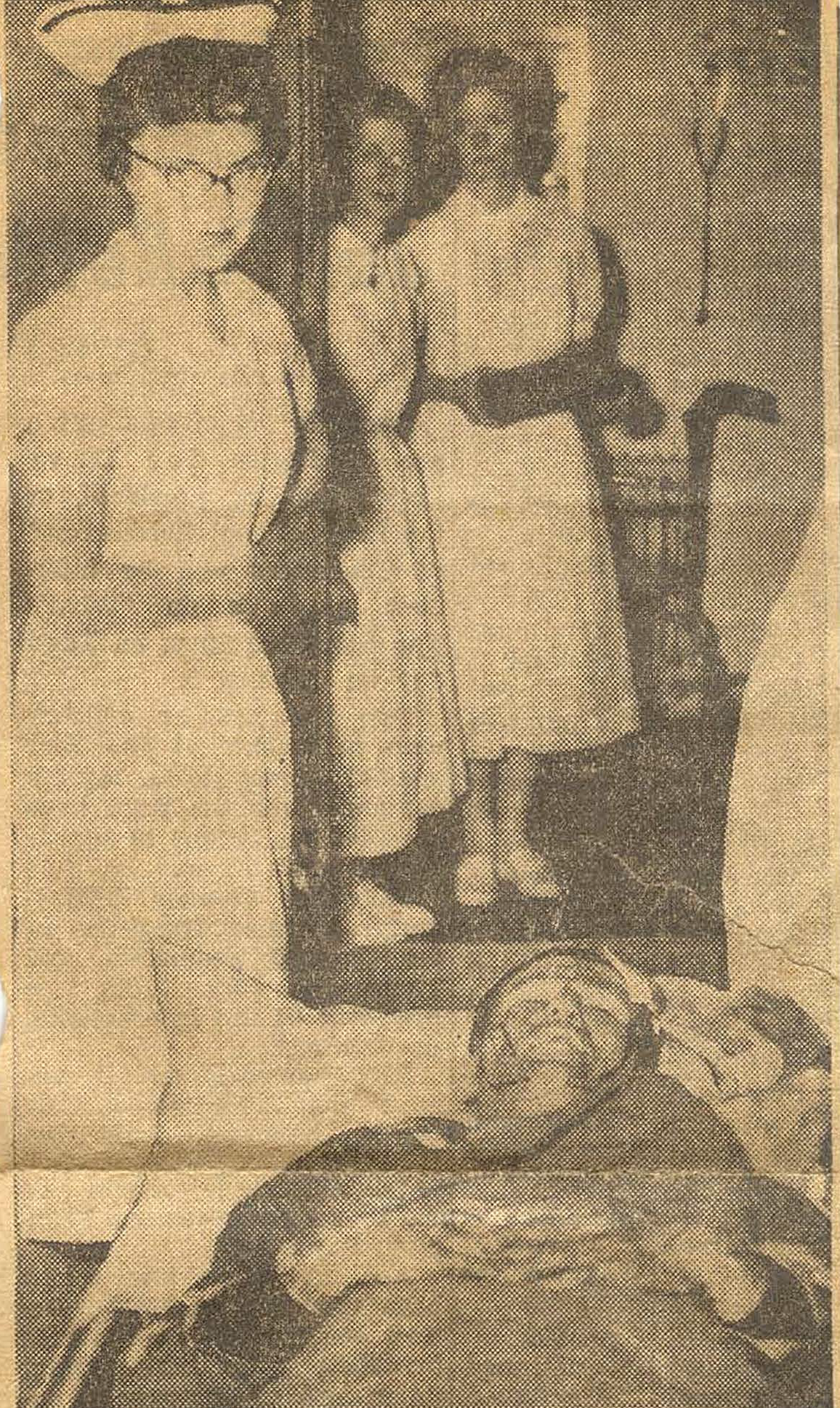
During his Naval service, Peter narrowly escaped death while climbing the 6,300-foot Chair Peak in the Cascades range of the Pacific Northwest. While leading a roped ascent, he slipped only 200 feet from the summit and fell 100 feet, landing near the edge of a massive drop-off. Though injured, he walked for six hours before meeting a rescue team, who then carried him on a stretcher for three more hours to a road and transport to a local hospital.
Academic Career
In 1959 Peter enrolled in the graduate program for astronomy at the University of California, Berkeley, where he became George Wallerstein’s first PhD student. In 1961 he married J. Carolyn Safford, and in 1963 he obtained his PhD with the dissertation “The atmospheres of metallic-line stars in the Hyades star cluster.” From 1963 to 1966 he was a research fellow at Mount Wilson and Palomar Observatories (California Institute of Technology, Pasadena), where he worked with and was inspired by Jesse Greenstein.
His talent for innovative research showed early: in 1965 he discovered a new class of sharp-lined early-A-type stars with peculiar abundances, resembling those of the metallic-line stars. This major breakthrough inspired new theoretical ideas for the origin of abundance anomalies in A-star atmospheres.

In 1966 he became staff astronomer and assistant professor at Lick Observatory of the University of California, Santa Cruz, a position he held until 1971. In Santa Cruz and later in Boulder, Peter and Carolyn hosted many dinners and gatherings of astronomers — both visiting and local — at their home.
“The atmosphere was usually exciting; one could almost see sparks of light released as ideas and academic references sped about the room. The creative energy was amazing.”
— Carolyn Conti
Peter’s early research interests were metallic-line stars and peculiar A stars, and the abundances of Li and Be in stars of different types. In 1969 Wallerstein and Peter co-authored a landmark review article about these light elements in stars for Annual Reviews of Astronomy and Astrophysics.
In 1969–1970, supported by a Fulbright fellowship, Peter was a visiting professor at Utrecht University in the Netherlands, where he worked with Anne Underhill, a specialist on the spectra and atmospheres of hot stars. His family joined him and his children attended Dutch schools. Here his interest shifted from A-type stars to massive hot stars — a field in which he would become one of the world’s foremost research leaders.
In 1971 he began innovative research with William Alschuler on the properties of massive stars. The spectral sub-types of O-type stars were quantized through measured line strengths, rather than eye estimates. They showed that the ratio of helium line strengths could be used to determine effective temperatures of O-types through calculations from model stellar atmospheres.
That same year he was offered a position at the Joint Institute for Laboratory Astrophysics (JILA) and a full professorship in the Department of Astrophysical, Planetary and Atmospheric Sciences (APAS) at the University of Colorado in Boulder. He would later serve as chairman of both JILA and APAS. He formally retired as a professor at the University of Colorado in 1996 but remained actively involved in astronomy until his untimely death.
Throughout his career, Peter proposed and led observing programs at the major ground-based observatories in Chile, Hawaii, and the US, and with the Hubble Space Telescope, to unravel the evolution of massive stars.

The Conti Scenario
One of Peter’s most remarkable traits was his talent for identifying new research areas where major advances in understanding could be made by applying clever observing techniques. Together with many students and postdocs, Peter launched a series of observing programs to disentangle the evolution of O-stars and Wolf-Rayet stars. He collaborated with international colleagues — observers and theorists alike — studying the connection between mass loss and stellar evolution. This large group became known as “the O-star mafia,” with Peter as “Godfather.” The group met every few years at conferences such as the Boulder-Munich workshops and the “IAU beach-symposia” to discuss rapid progress in the field and plan follow-up observations.
In 1975 this work led to the famous “Conti scenario” for the evolution of massive stars — describing the evolutionary connections and properties of the many subtypes of O-stars and Wolf-Rayet stars, including their luminosities, temperatures, atmospheric chemical composition, and the resulting supernova types. Peter presented this scenario at a conference in Liège, Belgium in 1975, where he was awarded the Gold Medal of the University of Liège.
In 1977 he spent a sabbatical as guest professor at the Universities of Amsterdam and Utrecht. In 1993, on the occasion of the 350th anniversary of astronomy at Utrecht University, he was awarded an honorary doctorate degree — with Henny Lamers as honorary promotor — “in recognition of his important contributions to our understanding of the physics and evolution of massive stars.” In 1995–1996 he returned to Utrecht for six months as a Minnaert Guest Professor.
In 1990 Peter turned his attention to “Wolf-Rayet galaxies” — galaxies whose integrated spectra show the broad emission feature at 4686Å commonly attributed to HeII emission from Wolf-Rayet stars. A major observational program, conducted in collaboration with many colleagues, revealed that nearly all are galaxies with recent, enormous, short-duration starbursts. This work was summarized in the graduate-level textbook From Luminous Hot Stars to Starburst Galaxies (Conti, Crowther and Leitherer, 2008 and 2012).
Peter described his own work as follows:
"My research deals with understanding the nature and evolution of massive luminous stars, those of the hottest spectral types. These are primarily O-type and Wolf-Rayet stars found in the Galactic plane and in other galaxies. In starburst galaxies, the numbers of these stars are sufficient that they may be detected collectively, even in those objects at very large redshift. I am currently emphasizing photometry and spectroscopy of luminous stars in our Galaxy in the near infra-red, at about two microns, where the absorption of the intervening Galactic dust is low."
Conti-fest
Peter retired from JILA in 1996. In 2008 he was celebrated with “Conti-fest” — a 4-day workshop entitled Hot Massive Stars: A Lifetime of Influence — held at the Lowell Observatory in Flagstaff, Arizona, organized by his former graduate students Kelsey Johnson, Margaret Hanson, and Phil Massey. National and international colleagues, former students, and postdocs gathered to pay tribute to the godfather of the O-star mafia.
During his career Peter served on many national and international organizations and committees, often as chairman:
- 1980–1986: Chair, Department of Astrophysical, Planetary and Atmospheric Science (LASP), University of Colorado
- 1983–1986: Chair of the Board, Association of Universities for Research in Astronomy (AURA)
- 1988–1991: President, Commission 29 “Stellar Spectra,” International Astronomical Union (IAU)
- 1989–1990: Chair, Joint Institute for Laboratory Astrophysics (JILA), University of Colorado
Between 1971 and 2001 he supervised nine PhD students and a number of postdocs at the University of Colorado, many of whom went on to hold important research positions.
Minor Planet Conti
Peter is represented in the sky: in 2019 the International Astronomical Union officially named minor planet 25961 “Conti.”
Minor Planet 25961 Conti is approximately 4.5 kilometers — about 2.79 miles — in diameter. It sits about 2.6 astronomical units from the sun, between Mars and Jupiter, and takes just over 4 years to complete one orbit, traveling in a nearly circular path.
Since 2018, Peter has been featured on the Albert Nelson Marquis Lifetime Achievement website in recognition of his outstanding contributions to science.
A Giant Has Fallen
Peter’s desire for exploration continued well into his retirement. He and Carolyn enjoyed many diverse travels during this time — living in Maui for a while, making trips to Europe and Russia to renew friendships, and exploring the South Pacific and the Eastern Canadian Arctic.

Part of one summer was spent camping on the land with Inuit friends near the Arctic Circle.

He will be remembered with admiration as a friendly and modest man by his students and colleagues, many of whom became good friends with his family.
Peter S. Conti is survived by his wife Carolyn, his three grown children Michael, Karen, and Kathe, and seven grandchildren.
Thank you to Henny J.G.L.M. Lamers and Ed P.J. van den Heuvel for writing and providing so many wonderful words and descriptions of Peter’s professional life.
Obituary
Peter’s obituary has been published by the American Astronomical Society and the International Astronomical Union.
International Astronomical Union — Peter Conti Member Page
Bulletin of the American Astronomical Society — Obituary
Memorial Service
Legacy Continues
